
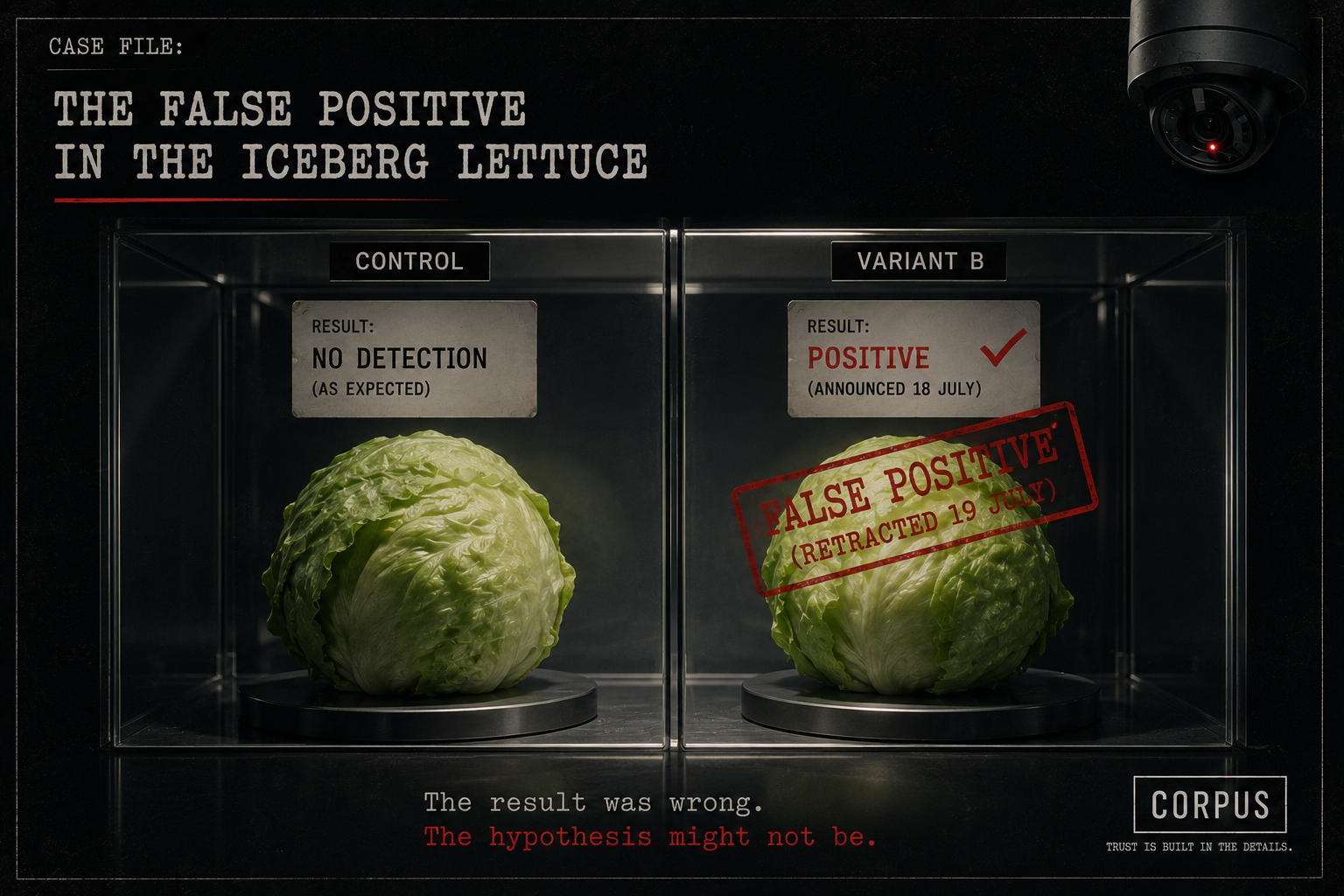
Have you ever made a decision based on a pile of evidence…
…and then had everyone fixate on the one number in the pile?
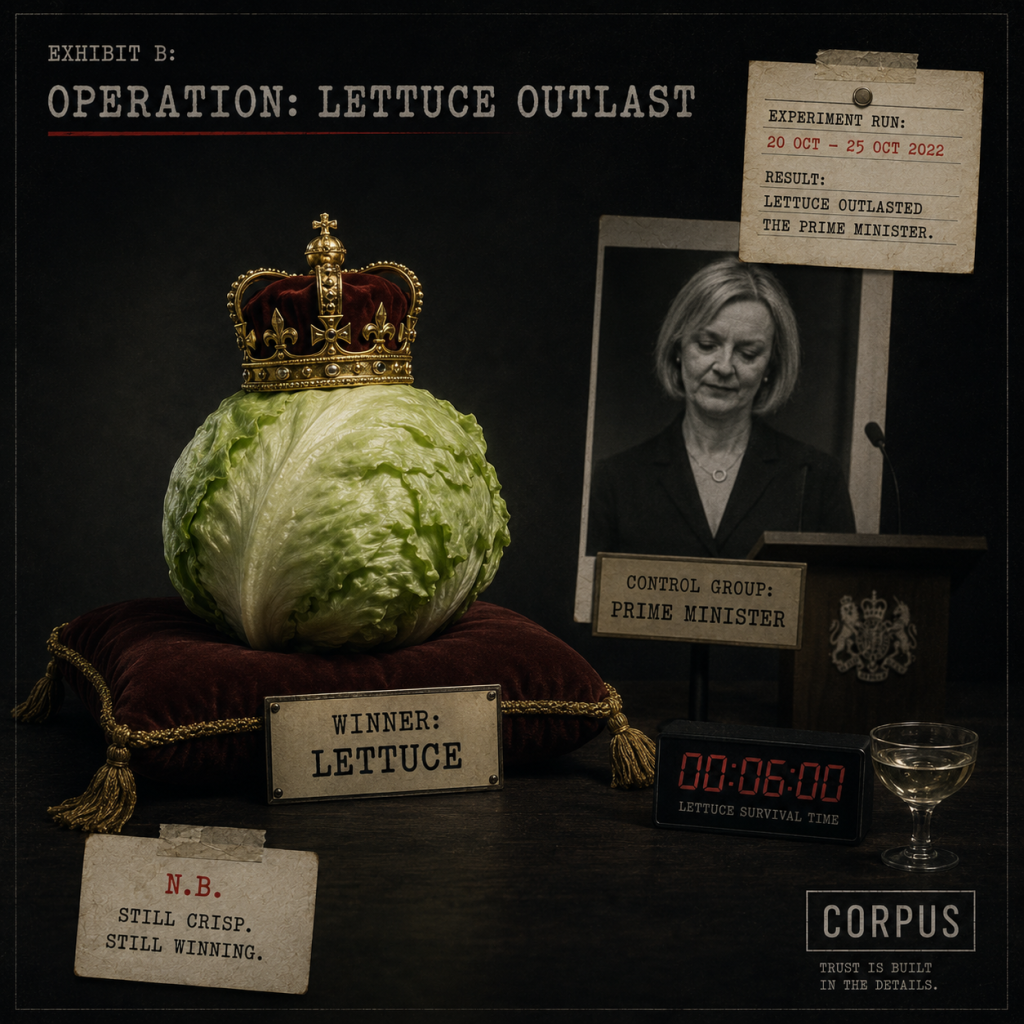
Britain has already established that an iceberg lettuce can provide a surprisingly effective measure of institutional stability.
In October 2022, the Daily Star placed one beside a photograph of Liz Truss and began a livestream to discover which would last longer.
The lettuce won.
Truss resigned six days into the experiment, while the increasingly decorated vegetable remained sufficiently intact to receive a golden crown and a celebratory glass of prosecco.
Four years later, another member of the lettuce family has found itself at the centre of a rather more consequential experiment.
This time, the question was not whether it could outlast a prime minister.
It was whether it had made 1,644 people ill.
Someone has already pasted the uplift into a presentation and added a projected annual revenue figure with rather more confidence than the situation warrants.
There it is: proof.
Except the following day, your analysts examine the result again. And the win disappears.
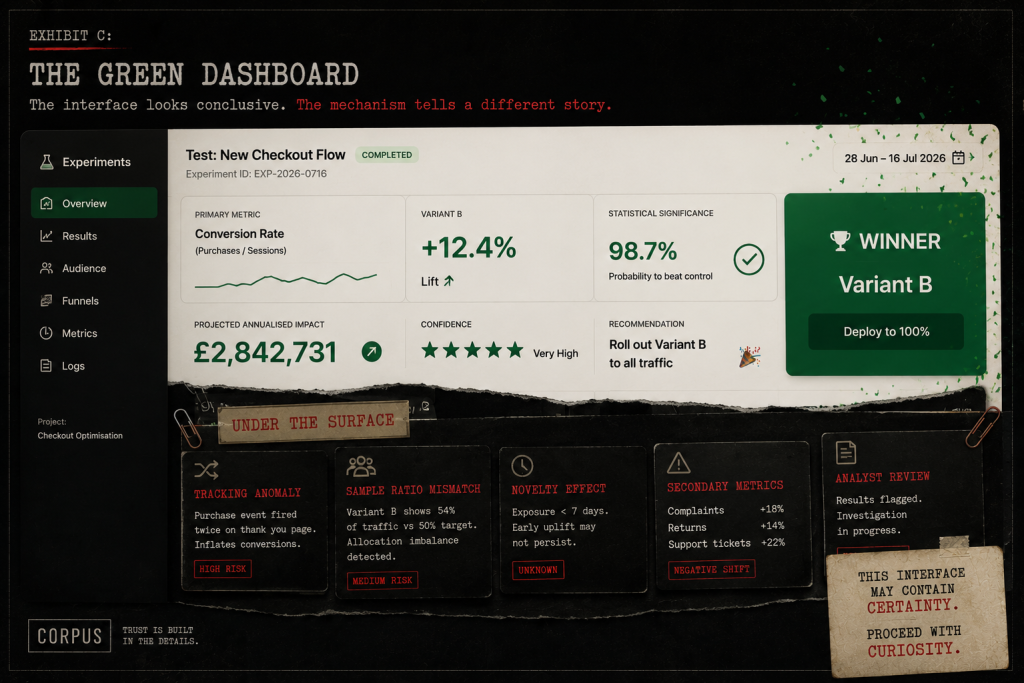
Because the original positive result should never have been declared positive at all.
What would that tell you? That the result was wrong? Certainly.
That the entire hypothesis was wrong? Not necessarily.
And that distinction sits at the centre of the Taylor Farms lettuce saga.
US health authorities had been investigating a large outbreak of Cyclospora, a parasite that can cause prolonged and deeply unpleasant gastrointestinal illness.
The cases had something in common.
They involved people who had eaten at Taco Bell restaurants in Indiana, Kentucky, Michigan, Ohio and West Virginia. Investigators examined detailed food histories from 190 cases, and 90% of those people reported eating iceberg lettuce.
The FDA then traced the lettuce served by the affected restaurants backwards through the supply chain.
Those routes converged on one supplier: Taylor Farms de Mexico.
On 17 July 2026, Taylor Farms began removing iceberg lettuce sourced from central Mexico from the US market and initiated a recall.
Then, on 18 July, the investigation appeared to acquire the piece of evidence everyone had been waiting for.
A sample of lettuce supplied by Taylor Farms tested positive for Cyclospora.
The interviews pointed to lettuce.
The supply-chain records pointed to Taylor Farms.
And now the product itself appeared to contain the parasite.
Hypothesis confirmed. Winner declared.
Except the next day, FDA laboratory specialists reviewed the result and concluded that the signal did not represent genuine amplification.
The positive result was a false positive.
As of 19 July, none of the tested product samples had produced a confirmed positive result for Cyclospora.
The apparently conclusive result was not conclusive.
It was not even positive.
For experimenters, this is a familiar fear.
A false positive is what happens when a test tells us that an effect exists when it does not
But the apparent difference may have been created by chance, faulty measurement, contamination, an analytical mistake or some other feature of the testing process.
The result looks real. It passes the mechanism intended to protect us from imaginary wins. And yet it is still wrong.
That is why statistical significance has never meant: We have proved that the variant is better.
It means something much narrower:
Assuming the test and its underlying conditions are valid, the observed result would be relatively unlikely under the null hypothesis.
There are quite a few escape hatches hidden inside that sentence.
A green dashboard does not repeal uncertainty. It merely gives uncertainty a more reassuring interface.
Once the FDA withdrew the result, Taylor Farms understandably emphasised that no product had produced a confirmed positive test.
And on the surface, the reversal appeared to destroy the case.
Positive lettuce test: the supplier was responsible.
False-positive lettuce test: the supplier had been wrongly accused.
But that assumes the laboratory result was the original reason for suspecting the lettuce.
It wasn’t.
The recall had already begun before the positive test was announced.
Investigators had reached Taylor Farms through a combination of evidence:
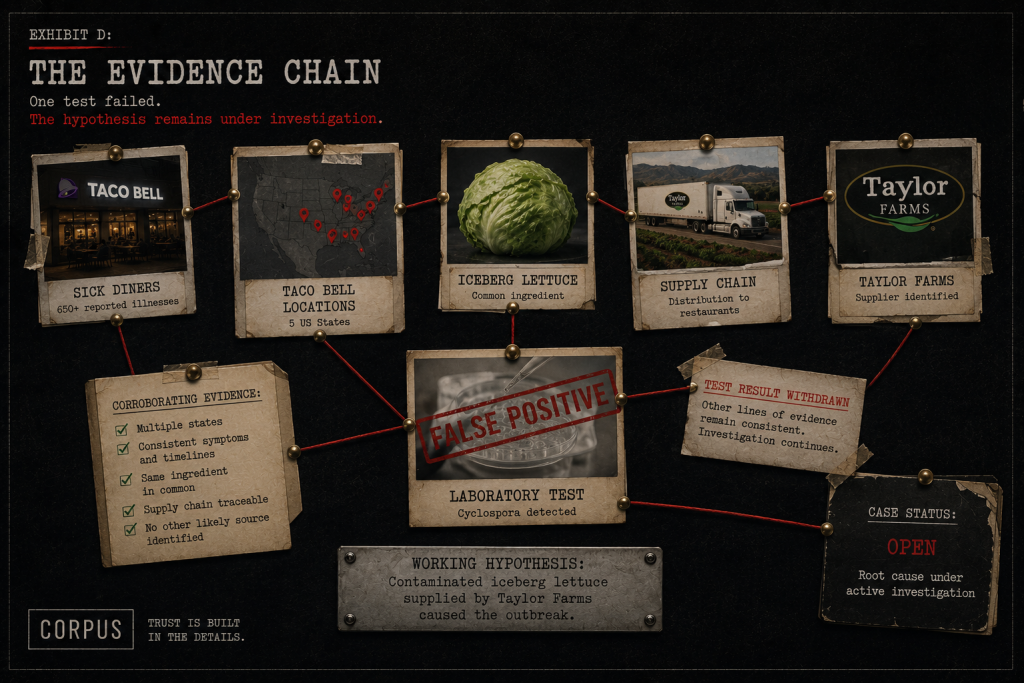
The laboratory result arrived later. It did not create the hypothesis. It appeared to validate it.
The FDA therefore maintained that withdrawing the result did not overturn the wider investigation, while Taylor Farms stressed that there was still no confirmed contaminated product sample.
Both positions contain something important.
The false positive weakened the case.
It did not erase every other piece of evidence.
Nor did the wider pattern magically make the faulty result valid.
The test was wrong. The hypothesis might still be right.
This is where the lettuce saga stops being a food-safety curiosity and becomes an experimentation problem. Because most organisations say they use multiple forms of evidence.
And suddenly the experiment becomes the evidence.
Everything else is demoted to interesting background material.
A neat causal story is constructed around it: We ran the test. The variant won. Therefore the change caused the improvement.
That story is easier to explain than the truth:
We observed a result within a system containing users, interfaces, acquisition sources, technical dependencies, operational changes, external events and a substantial amount of uncertainty.
One version fits comfortably on a slide. The other tends to ruin it.
So we remember the green result and forget the evidence chain underneath it, until the result is questioned.
Or perhaps, like the lettuce sample, the positive result was never positive in the first place.
At that point, teams often swing from excessive certainty to excessive dismissal.
But a failed experiment result tells us something about the result. It does not automatically settle every question surrounding the hypothesis.
At Corpus, we treat experiments as part of an evidence chain rather than machines that manufacture verdicts. A result becomes useful when we can connect it to the surrounding reality:
The aim is not to undermine experimentation. It is to stop demanding more certainty from an experiment than it can provide.
A false positive matters. It can waste money, misdirect strategy and persuade an organisation to scale something that never worked.
But the greater failure is often narrative. We allow the cleanest result to replace the entire body of evidence. Then, when that result fails, we discover that nobody can remember why the decision made sense in the first place.
The FDA may eventually establish that Taylor Farms lettuce caused the outbreak. It may establish that it did not.
For now, the honest position is more awkward: The product test was wrong.
The wider investigation still points towards the lettuce.
And one iceberg has already taught Britain that sometimes the most revealing part of an experiment is simply seeing what remains standing at the end.