
Corpus exists to help organisations understand why trust, clarity, and performance often break before someone reaches the website.
It treats conversion as a downstream symptom of belief, not the starting point of the problem. That belief is shaped by what is true, what the world repeats, what machines infer, what people expect, and what the interface finally proves. Corpus is the framework for making those layers more coherent.
Who this article is for:
This article is for people responsible for growth, UX, content, ecommerce, search, brand, or customer experience who suspect the website is being blamed for problems that actually start elsewhere.
It is especially relevant when performance feels fragile, trust feels unstable, or the business keeps fixing the page without fixing the conditions shaping belief before arrival.
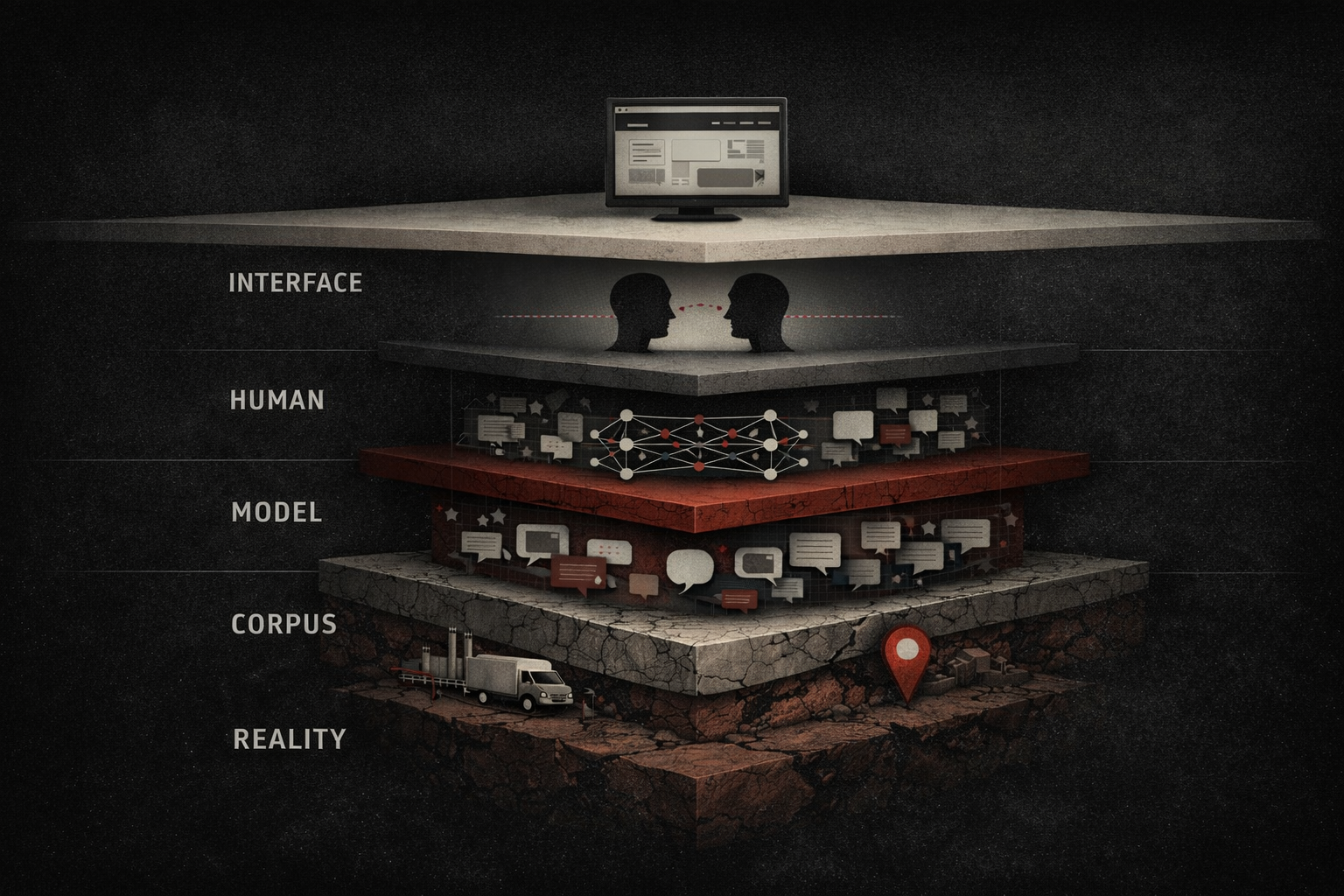
Corpus is a clarity and trust framework for the upstream web. It helps organisations diagnose how they are interpreted across five layers: reality, corpus, model, human, and interface. Its purpose is to reduce contradiction, strengthen proof, improve machine and human understanding, and identify where trust is breaking before, during, or after the click.
The default diagnosis is still painfully familiar.
If performance is weak, the problem must be on the website.
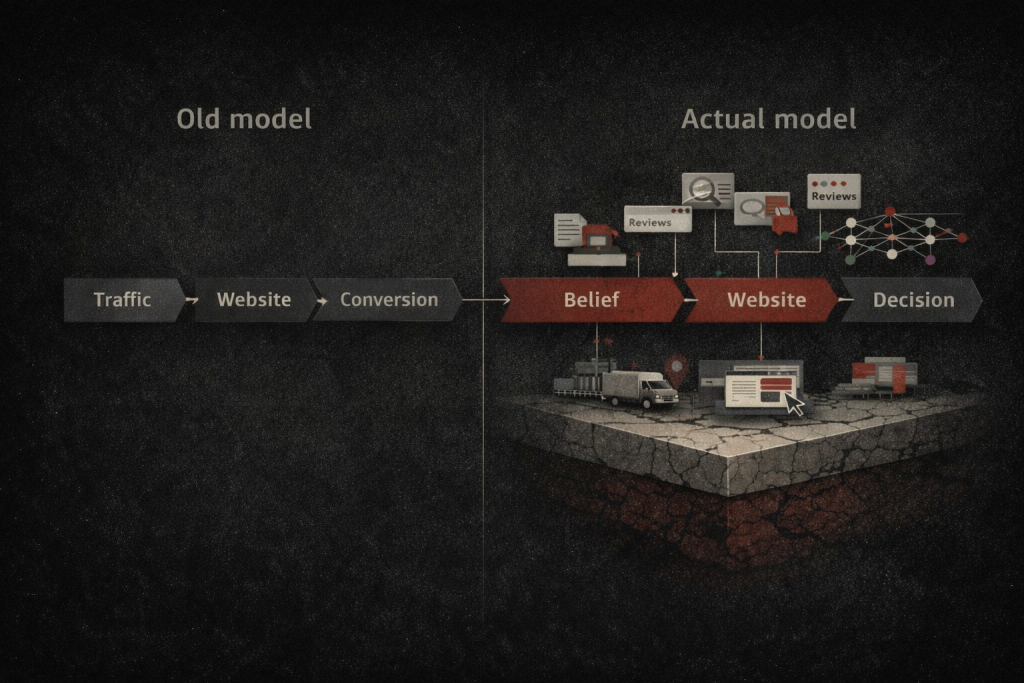
So teams tighten the headline, tweak the layout, simplify the checkout, add social proof, rewrite the CTA, and hope the numbers behave. Sometimes that helps. Often it does not, because the website is no longer the whole decision environment.
People do not arrive empty-headed. They arrive carrying impressions, assumptions, warnings, comparisons, summaries, proof gaps, and whatever else the wider web has already taught them to believe. The site is not always the first impression anymore. Quite often, it is where that earlier impression is confirmed or broken.
That means many teams are still working at the wrong layer. They are trying to solve a system problem with interface polish.
Corpus is a framework for understanding how trust and interpretation work across the full decision environment, not just the page. It uses five layers:
Operational capability, delivery times, pricing truth, return policies, stock, product quality, service standards, and practical constraints.
Reviews, listings, search results, forums, Reddit, social posts, comparison content, support chatter, and creator narratives.
AI summaries, search understanding, entity recognition, structured meaning, inferred confidence, consistency, and contradiction.
Expectation, risk, urgency, category understanding, credibility thresholds, emotional context, and prior assumptions.
Content, UX, UI, structure, navigation, semantics, accessibility, checkout, and interaction design.
These layers interact.
Reality creates the facts. Corpus distributes and distorts them. Model interprets the distributed record. Human forms expectations from those signals. Interface then confirms or breaks the story.
Which means the interface is often not the root cause. It is simply where the truth finally becomes undeniable.
That is what Corpus is actually for: helping organisations diagnose the system shaping belief, not just the page inheriting it.
EXAMPLE:
Take a retailer promising fast delivery.
The ad suggests speed. The search snippet implies speed. The product page repeats it. The buyer clicks because speed matters.
Then checkout reveals a steep delivery fee and a slower-than-expected window.
At that point, the UX team often inherits the corpse. Drop-off appears in the funnel. Checkout becomes the murder scene. But the actual cause of death is upstream contradiction.
The offer did not match the signal. Reality did not support the claim. Trust snapped when the hidden truth appeared too late. That is not just a UX problem. It is a coherence problem spanning claims, offer, reality, and signals.
Once you start looking through this lens, a lot of supposedly separate problems collapse into one another.
A conversion problem may actually be a truth problem, where operations cannot support the promises being made.
A bounce problem may be an expectation problem, where the visitor arrives believing one thing and meets another.
A visibility problem may be an entity problem, where facts, naming, or definitions drift across surfaces and machines cannot form stable understanding.
A trust problem may be a proof problem, where claims are loud and evidence is weak or missing.
This is why Corpus includes CORPSE triage: Claims, Offer, Reality, Proof, Signals, Entity. It is used to inspect a specific page, product, service, offer, or journey and identify what is actually breaking. Each letter names a distinct failure mode: credibility, expectation, truth, doubt, reputation, and identity.
Most organisations still respond to these problems with partial nonsense: improve the copy, add more trust signals, do SEO, optimise for AI.
Sometimes those things are not wrong. They are just incomplete.
Corpus exists to cut through that.
If the page is underperforming, the first question is no longer “how do we improve this page?”
It is: what has already been taught, implied, repeated, or inferred before the visitor got here?
That changes the work.
NOTE
If you only optimise the page while the wider system remains contradictory, you are polishing the confession booth while the evidence is still on fire.
The result is usually fragile performance, wasted optimisation effort, unstable trust, and a business that keeps blaming the interface for problems rooted in reality, proof, signals, or entity drift.
Humans and machines do not interpret the world in the same way, but both are damaged by contradiction, inconsistency, weak proof, and unstable identity.
Humans arrive with expectations already formed. They are asking: does this feel credible, safe, fair, clear, and worth the risk?
Machines are trying to identify what the business is, what it offers, whether facts are stable, and whether the record is coherent enough to summarise or recommend with confidence.
When those systems align, the website gets to do its real job well: help people confirm, understand, and act.
When they do not, the website becomes a witness box for promises the rest of the business cannot support.
That is why Corpus treats trust as a system, not a slogan.
Start with one offer, one journey, or one key page. Do not begin by trying to fix the whole brand in one heroic fit of executive optimism.
A practical starting exercise is simple:
Compare your ad promise, search snippet, product or landing page, delivery or returns terms, and visible off-site review or listing copy for the same offer.
Then ask:
Then prioritise fixes in the right order:
Corpus fits before the usual scramble to improve the page.
It gives you a strategic framework for diagnosing where trust is breaking across the five layers, and a practical triage model for inspecting specific journeys, pages, products, or offers. The five layers help determine whether the problem is really on the page or whether the page is simply where the lie finally becomes visible. CORPSE then helps identify what kind of failure you are actually dealing with.
So what is Corpus actually for?
It is for reducing contradiction.
It is for strengthening proof.
It is for improving machine and human understanding.
It is for aligning operational truth with the stories told across the upstream web.
It is for helping organisations stop treating interface symptoms while the real disease spreads elsewhere.
In other words: Corpus is for the work that has to happen when “just improve the page” is no longer an honest answer.