
Yesterday OpenAI emailed me, and whilst I’d ordinarily just shift-delete any form of “communication trying to sell me something”, this one actually got added to their open rate. Why? Because they wanted me to buy advertising. An immediate red flag to this old bull, who quite frankly is fed up with being advertised at by nearly every bloody “thing” I use, watch or listen to, unless I pay for the privilege of being ad-free.
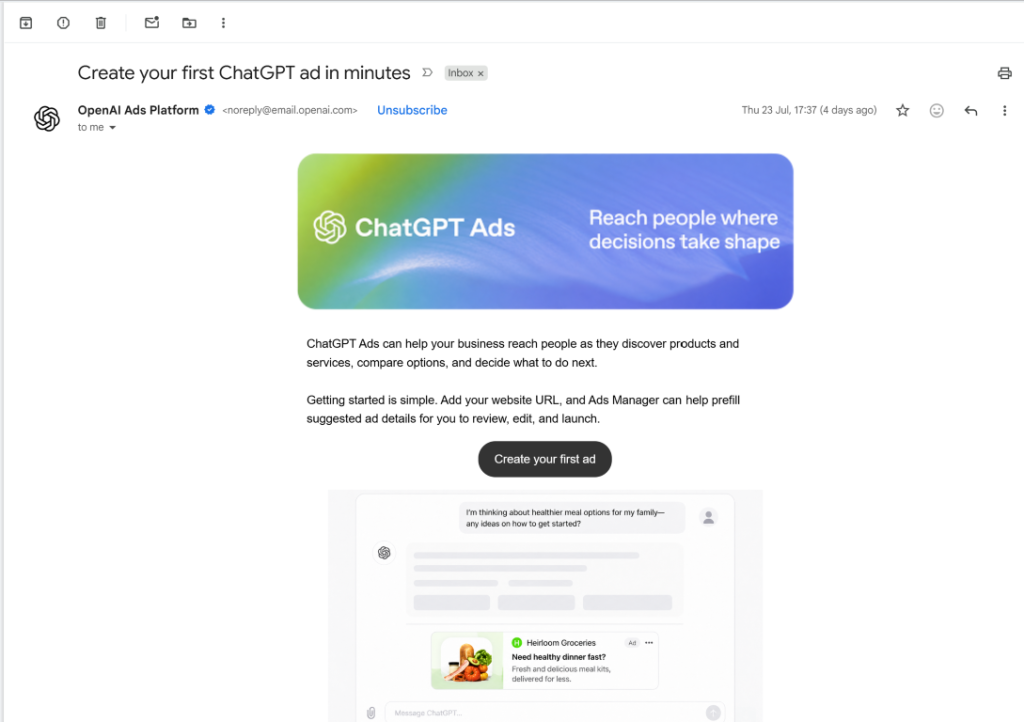
Given that I pay for ChatGPT, like almost everything else, I haven’t actually seen adverts inside the product yet, although, to be fair, I’m sure they’ll make their way to my tier soon enough. What piqued my ever-curious mind was that this email was pitching the other side of the equation. The dark side.
As I skimmed through it, one line stopped me in my tracks:
“Reach people where decisions take shape.”
Oh hello. This has basically been my mantra for the past year, so I’m glad OpenAI has finally caught on. They can thank me later. But beyond the “told you so” response, the next one was actually more like:
“Oh f*ck.”
I’ve been chewing on why that was my response for a while now. Okay, overnight. And why that sentence bothered me so much. I’ve been everywhere with it. Maybe it’s because I’m tired of everything trying to sell me something. YouTube. Facebook. Instagram. Google. And the foreboding of a particular Black Mirror episode seems to be coming true.
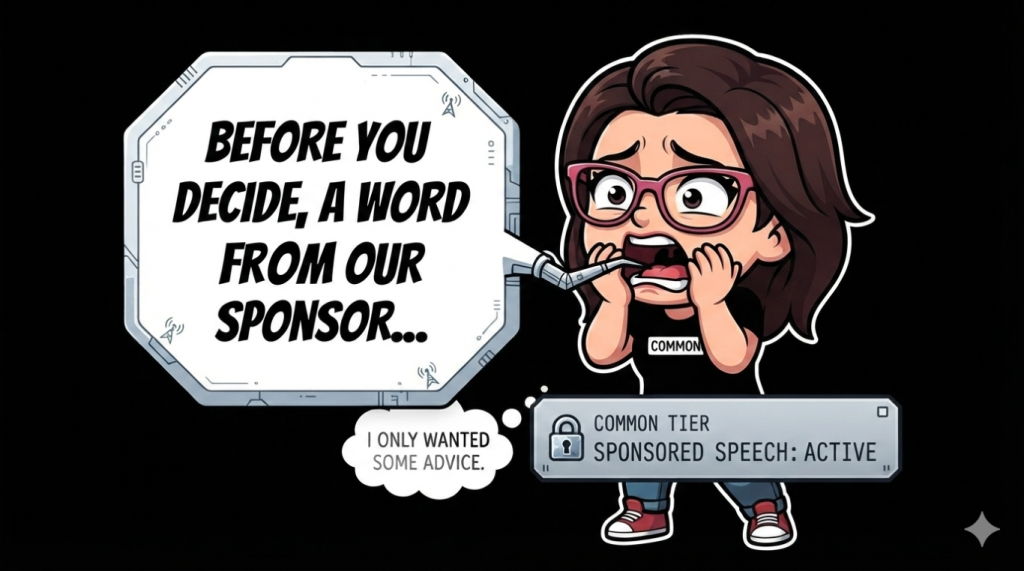
Whilst I think my first physical response was valid, after giving it more thought, the profanity was probably more related to one word: decision.
Google has spent years monetising attention. You searched. You clicked. Sometimes you got the answer you wanted. Maybe. Most of the time you got ten pages of websites all trying to convince Google that they deserved to be first, depending on whose budget was biggest and whose SEO team could play the game the bestest.
It absolutely isn’t perfect, and I hate seeing what it used to be “back in the day” compared with now, but if you’re determined enough, you can still get to a result that feels less procured, provided you’re willing to dig beyond page one.
A conversation with AI feels different to that. When I use ChatGPT, I’m often not really looking for information. I’m usually trying to make my mind up about something, work through an idea, or sanity-check that my level of crazy hasn’t hit DEFCON 1. That is entirely different from firing up The Google and hoping for the best, and all of this rambling got me wondering about something.
If Google sells attention, what TF is OpenAI selling, exactly? Or even vaguely?
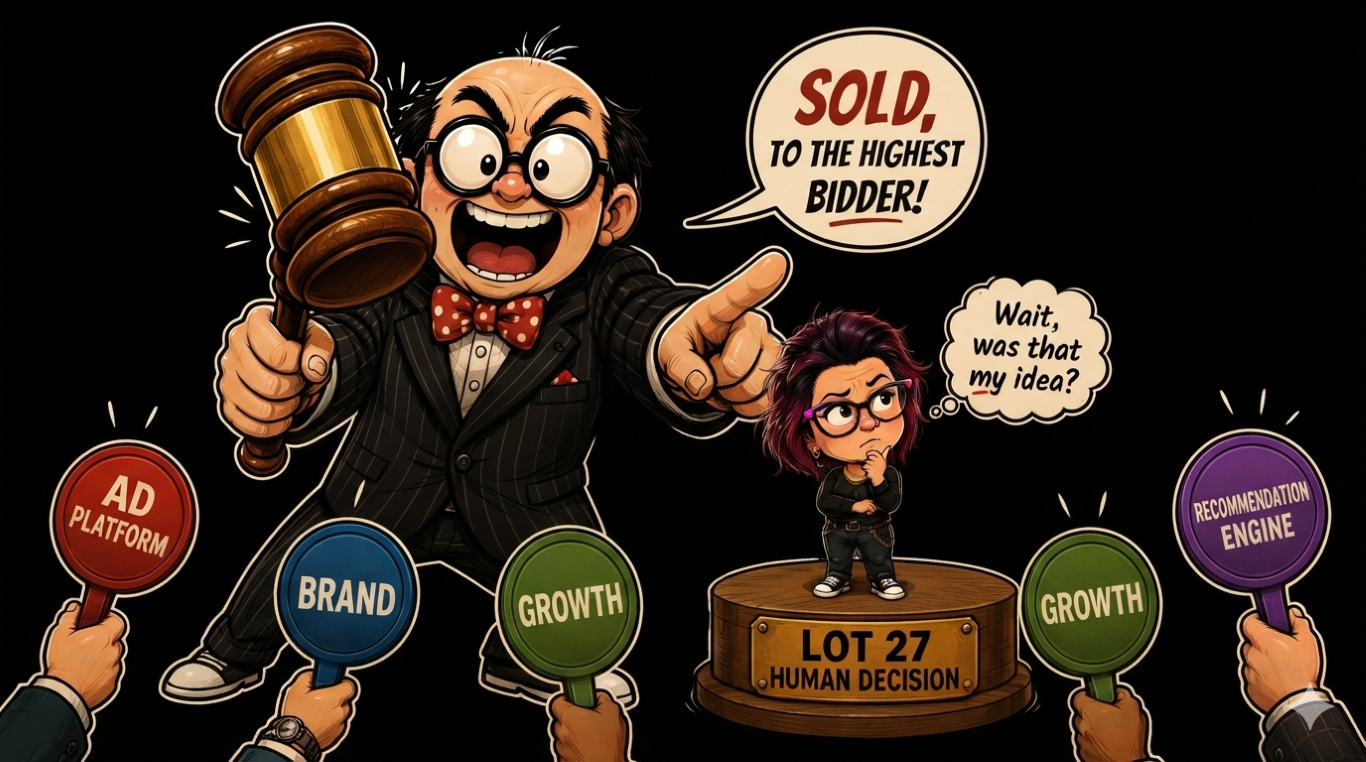
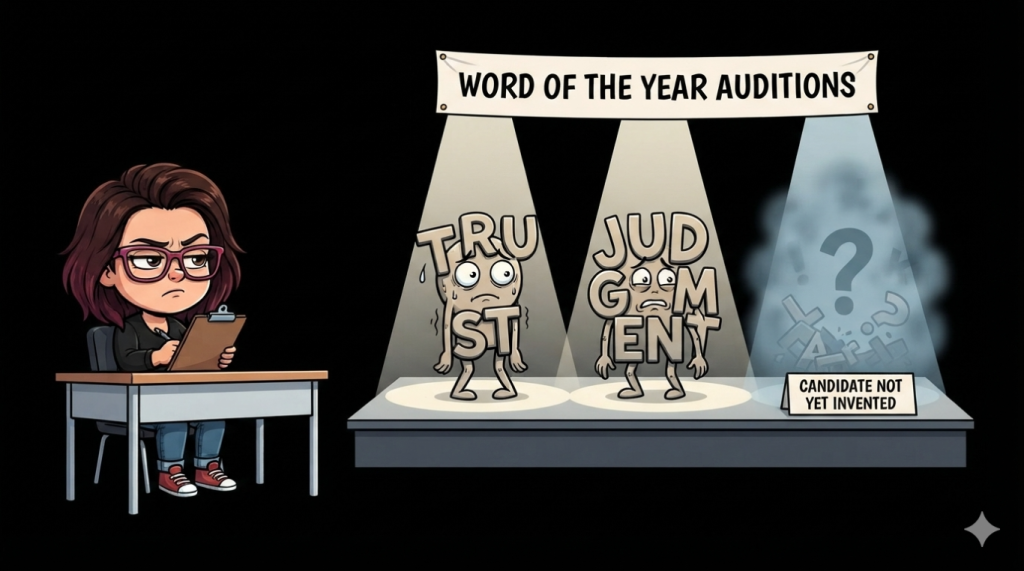
Is it trust? I’m not sure that’s quite right. I reckon it’s something else. I think it’s the point where you stop weighing things up and start thinking, “Sounds like a plan… let’s go!”
Maybe that’s still trust. Maybe it’s judgement. Maybe I’m still trying to find the right word for it, or maybe that word hasn’t yet entered the arena of candidates for Word of the Year from the Oxford Dictionary.
And yes, before anyone starts composing the “actually…” comment, I know the official line: ads are separate, clearly labelled and won’t influence the answer. Lovely. I’m not saying that’s false. I’m saying incentives have a funny way of becoming architecture.
I’m also not quite willing to lay down a prediction that ChatGPT is about to become Google circa 2015. [Extra side-eye suspicion.]
This ain’t my first rodeo, though. I’ve seen this play out before, which is one of the few benefits of being ancient and having worked in this industry for 20 godforsaken years. Yes, the stadium might be different, but the raging bull is the same.
The problem, as I see it, is basically humans. Harsh? Nope. Give us a system and sooner or later we’ll find a way to game it.
Google got SEO. Facebook got engagement bait. TikTok got algorithm hacking. So what does ChatGPT get?
People trying to become the recommendation and, inevitably, people selling courses explaining how to become the recommendation. You know they’re coming, because snake oil is in fact the new Brent equivalent, now available with Trump Promise trimmings.
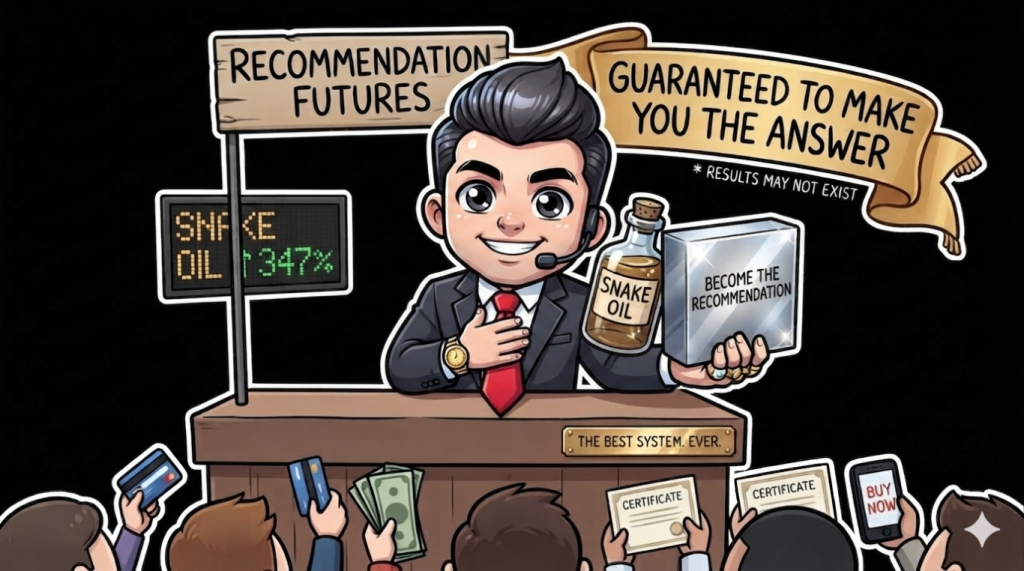
The optimist in me would like to think, however, that the answers don’t actually have to become biased. Imagine they stay completely independent. Imagine the model is genuinely trying to help. Would allowing an advertiser to appear beside you at the point where you’ve almost made your decision be enough anyway?
I don’t know. I genuinely don’t know. But I think that’s a more interesting question than whether the model itself is biased.
I guess, for once, having a brain fart a year ago and deciding to start looking into all this has actually paid off a bit. Websites. Brands. Search. AI. They’re all different things with the same problem: trust.
Or maybe incentives? Actually… probably incentives.
I’d like to think that organisations and people don’t usually wake up one morning and decide to make things worse. What they do is respond to whatever rewards the system puts in front of them. Sometimes that’s a perfectly sensible commercial incentive. Sometimes it’s ruthless, ego-driven, humanity-hating ambition because decency and consequence have left the building.
The latter is why, when you look at the internet now, all the platforms using it, and the power they invoke over mere mortals, you feel like you need a shower.
Meh, maybe none of this happens. Probably will. But I genuinely hope reason and sense enter stage left and state their case.
If I were designing conversational AI — hey OpenAI, waves, pls get in touch — I don’t think my biggest engineering problem would only be stopping hallucinations. I’d be spending just as much time asking a different question, because following the obvious, as most people know, is not my bag:
“How the f*ck do we not turn trust into advertising inventory?”
Because once trust has gone, you can’t get it back. Ask any relationship counsellor. It’s true.