
Buying car parts online is a bloody nightmare if, like most normal people, you don’t carry your engine code around in your head. So retailers have come up with various ways of removing some of that uncertainty for those of us who do not identify as Petrol Heads.
Amazon calls its version Confirmed Fit.
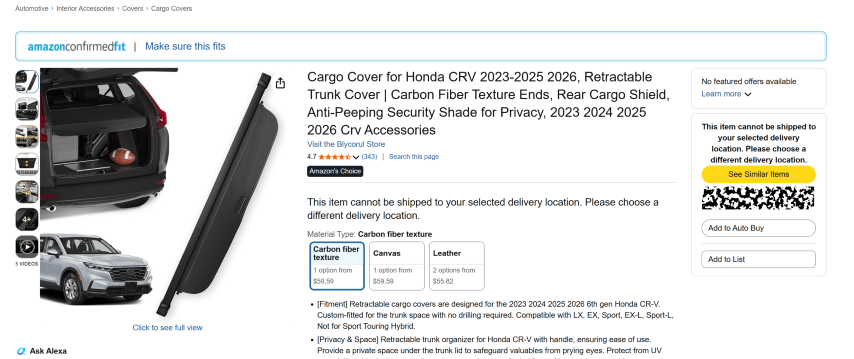
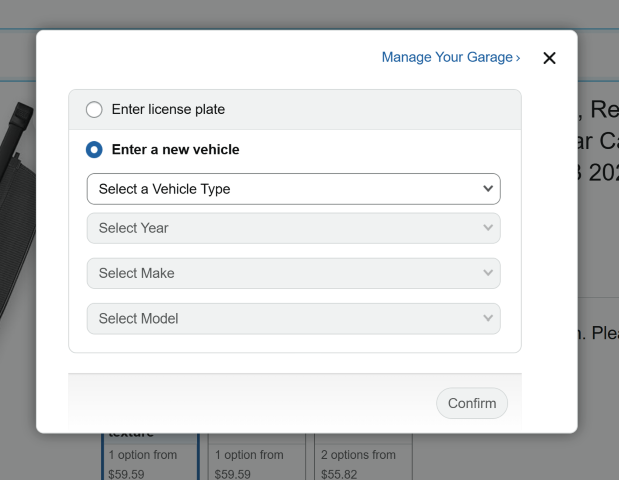
The process is as straightforward as the name fronting it. On a product page you can select “Make sure this fits”, tell Amazon what you drive (you can enter a licence/reg plate or choose the vehicle yourself) and then ask it to make the judgement call.
For my test run, I chose: Cars & Trucks → 2026 → Honda → CR-V
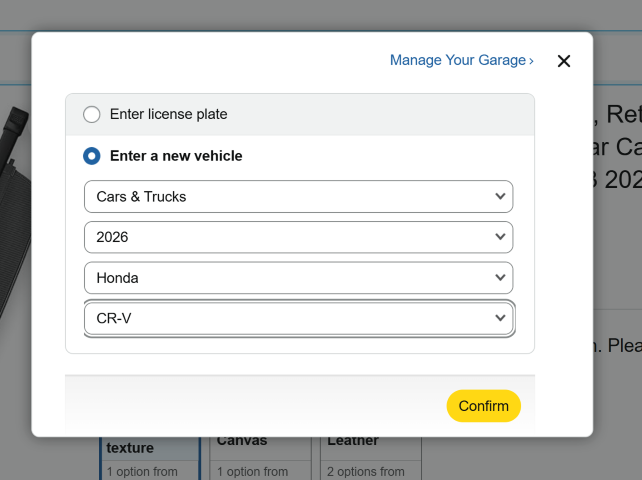
No, I don’t own one, that dream died along with my formative teenage years. However, I did press Confirm to see what happened next.
The point to remember here is the context… because it changes this post from being “urgh whatever” to something a bit deeper than “Abi having a rant about poor UX again, here we go…” so read on.
I haven’t simply searched for “Honda CR-V cargo cover” and decided for myself whether the seller’s description looks plausible. I have given Amazon detailed information about a specific vehicle and explicitly asked its system to decide whether this particular product satisfies that condition (and therefore my apparent need to buy a car cover for a Honda).
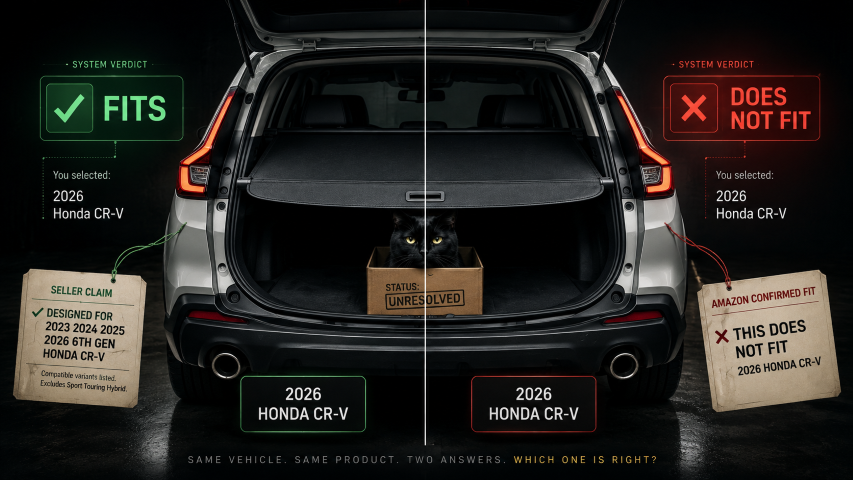
Amazon’s answer was in fact beautifully blunt: This does not fit.
I do love bluntness, as most people know. And this would ordinarily be wonderfully useful, except for one teeny tiny problem… because I also love getting into the details.
You see the product was called “Cargo Cover for Honda CRV 2023-2025 2026” – out front and centre, top of the page hierarchy (Amazon Ember, font weight 400, font size 24px in case you we wondering).
Further down the same page, the seller stated that the cover was designed for the 2023, 2024, 2025 and 2026 6th generation Honda CR-V, before listing compatible variants and excluding the Sport Touring Hybrid.
Same page. Same product. Same year, make and model. Except one system says yes. Another says no. Which is telling the truth?
I can’t tell
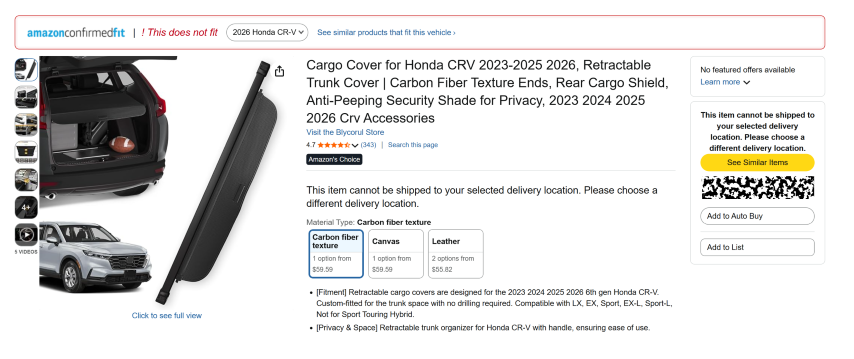
And as most people also know, I hate contradiction almost as much as I hate crap filtering. And, as the shopper, I shouldn’t need forensic database skills to work out which part of an Amazon product page I’m supposed to believe.
Now, there may be a perfectly sensible explanation. Amazon may have better compatibility data. The seller may have made the title too broad. Whether that was error, catalogue sloppiness or enthusiastic search coverage is unknowable from the page). Maybe trim information matters and would change the output. But as Amazon didn’t ask me for it, I’ll never know.
What Amazon is doing here might look rather different from an ordinary ecommerce filter. Whether that’s the traditional column down the left or one of those horizontal filter bars that appears to have been designed specifically for people not to notice it. Structurally, though, Confirmed Fit is doing the same job.
A filter simply performs that judgement across a larger set of products.
This is where a new paper: Help or hurt? When platform filters contradict product attributes in online retail, published in the August 2026 Journal of Retailing and Consumer Services becomes rather interesting…
It looked specifically at what happens when retail filters contradict the products they return (or in a user’s experience model, why when you select a particular filter on purpose but for some reason or another you get a load of irrelevant stuff shoved back in your face).
Across those studies, inconsistencies between filters and product attributes reduced how diagnostically useful shoppers considered the filter, lowered purchase intention and were associated with poorer product ratings. Their example includes selecting a filter for natural products and then finding products containing artificial ingredients among the results.
To the uninitiated it might seem that the obvious diagnosis is bad tagging. Someone put the wrong attribute in a database. But it’s an easy fix right? Just sort out the taxonomy and move onto the next ticket.
But what that surface level interpretation misses is what your actual shopper just experienced. That might be far more complicated than simply closing a ticket and thinking the job is done.
But put yourself in their shoes. If you applied a filter marked “100% natural” whilst on your mission to find natural products, for you, it’s not just a click. It’s way more than that.
You have stated a condition.
And so, the promise is that the retailer has acknowledged that condition and will change the results to be relevant on that condition. And from there, the filtered results themselves become evidence that the condition has been applied.
But as you’re scrolling through the results you notice a product containing artificial ingredients has been surreptitiously inserted. As a user, what does that mean to you?
The researchers describe filters as “meta-level selection rules”. To put that into plain English, they’re the logic used to decide what makes the cut. That horribly academic phrase is actually rather useful, because it gets at what filters really do.
They don’t just organise products.
They make a claim about the logic used to include and exclude them.
And sometimes that claim matters somewhat more than my usual dalliance on a shopping spree such as whether I fancy the blue pants or the green ones. They can be as important as:
Each one is making the promise to the user:
I understood your constraint, and I removed the things that do not satisfy it.
If we break that promise, we break a user’s trust in our ability to really understand what they want.
If we take a step back from what I suppose we would now call “traditional online shopping”, AI-mediated shopping changes how those constraints are expressed. We don’t necessarily have to find the right filter anymore because the sentence itself contains the conditions that must be fulfilled. We simply describe what we need.
And hopefully, the system translates the request into constraints, finds candidate products or services, and gives you a smaller set of apparently suitable answers.
It claims to have understood what must be true about those things.
Which means this problem of trust and constraint gets considerably more interesting when the underlying information is wrong.
A retailer can have a beautifully designed interface, excellent filters, intelligent recommendations and an AI assistant capable of discussing roof racks in the manner of an unusually enthusiastic Halfords employee.
But absolutely none of that matters if the data beneath it cannot support the confidence of the answer. The model doesn’t need to hallucinate (it does enough of that already). It can faithfully repeat a perfectly structured piece of gibberish if the information underneath it is wrong.
Amazon isn’t alone in turning compatibility into a verification service. eBay’s Guaranteed Fit works on the same broad principle: identify the vehicle, compare it with compatibility data, then tell the shopper whether the part fits.
Both of these solutions illustrate the dependency chain beautifully:
And the interface then compresses that entire dependency chain into a verdict:
✓ Fits your vehicle
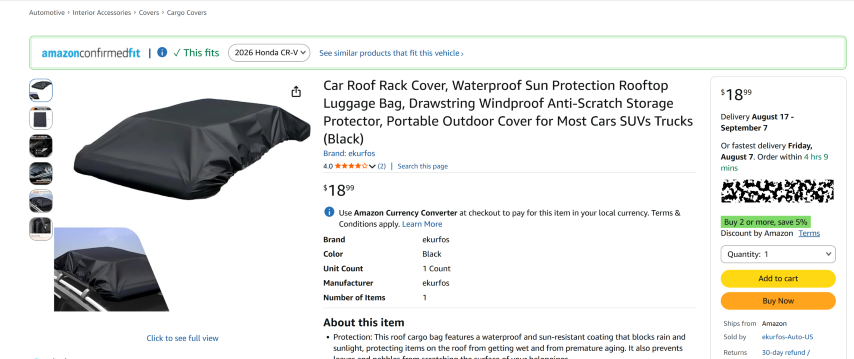
All the mess disappears… at least until something disagrees with it.
Sometimes that something is Reality: the physical part arrives and refuses to fit the physical car. In the Amazon example I found, we didn’t even get that far. The contradiction was already sitting on the product page, with the seller’s compatibility claim and Amazon’s compatibility verdict disagreeing before anybody bought anything.
At that point the interface is no longer reducing uncertainty. It is manufacturing it.
Your shopper doesn’t give two hoots which database committed the murder. They simply know the system has stopped being a reliable shortcut.
Through the Corpus lens, this is not one broken filter.
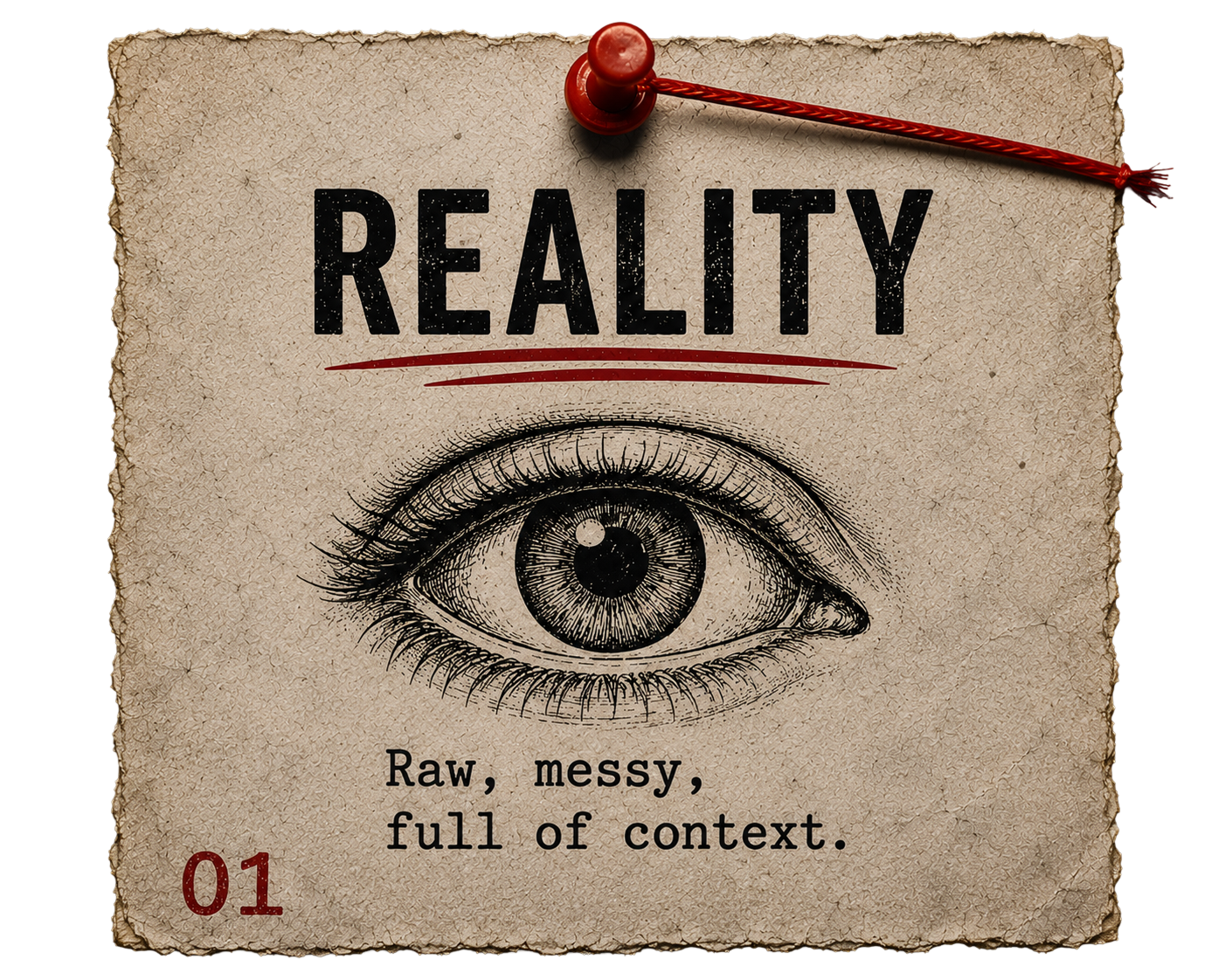
Reality

Corpus
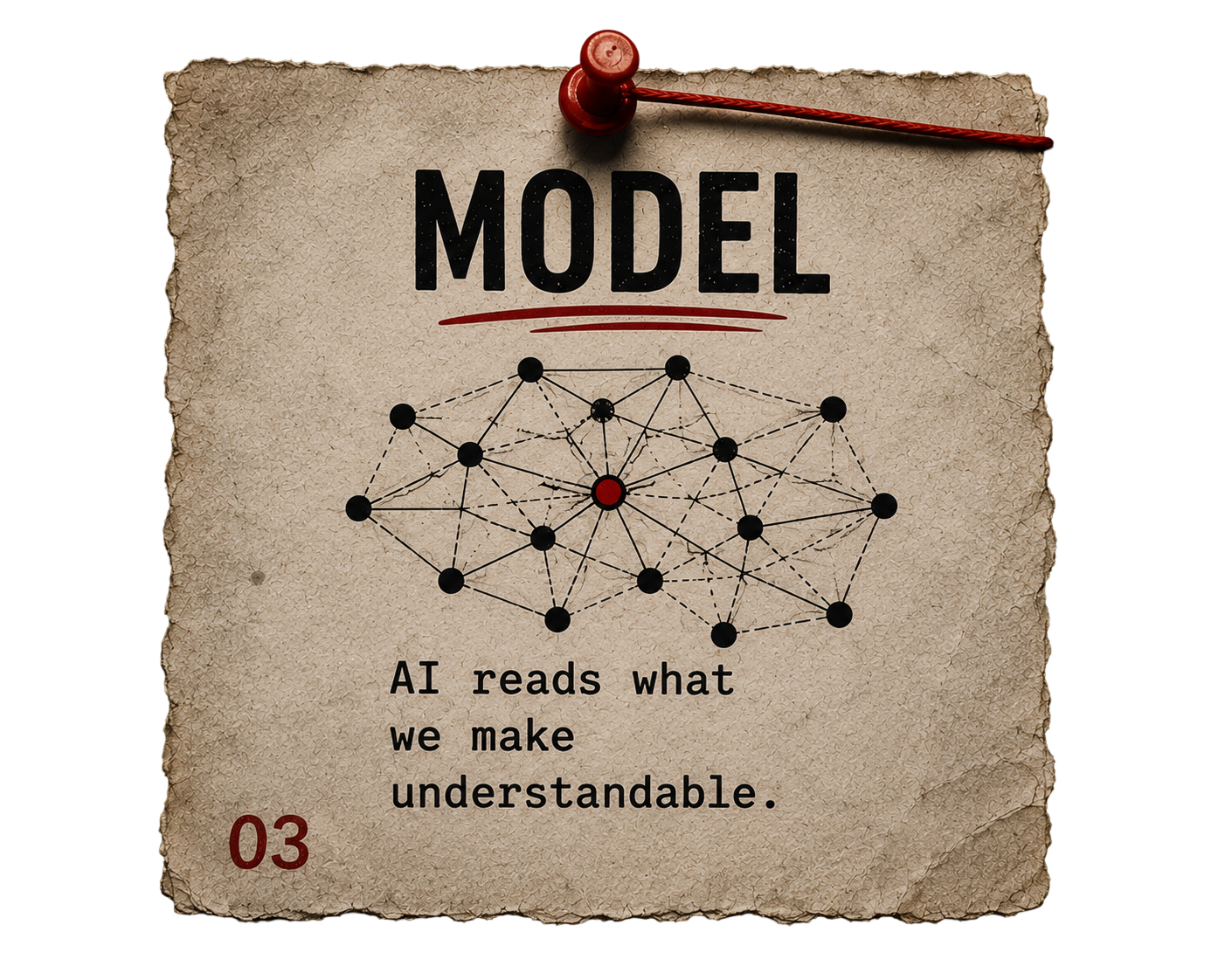
Model
Human

Interface
The interface may be functioning exactly as designed but that does not make the answer true.
And this is why these failures are easily misdiagnosed.
You can inspect the front end and conclude that the component works. The selected vehicle is visible. The compatibility message renders. The right icon appears. Nothing is technically broken.
The contradiction exists between layers.
You could redesign the filter until your Figma subscription expired and never touch the actual problem. Checkboxes are inherently boring UI components. The promises they make aren’t.
As soon as an interface says it has checked something for us, we quite reasonably start behaving as though something actually did.
Which I’m sure is enormously reassuring while staring at a 2026 Honda cargo cover that simultaneously does and does not fit a 2026 Honda.